Easiest Way To Manage Bitcoin Finances | A Bitcoin For Business Guide
Highlights
- Multi-sig wallets are essential for business security: A multi-signature wallet requires more than one private key to authorise a transaction. In a 2-of-3 multi-sig setup, for example, keys might be held by the CEO, the CFO and a trusted third-party security firm, meaning a transaction only proceeds if at least two of the three parties sign off.
- Every Bitcoin transaction is a taxable event in Australia: The ATO classifies Bitcoin as a CGT (Capital Gains Tax) asset rather than as money or foreign currency. This means that paying employees, paying vendors or even swapping Bitcoin for another cryptocurrency all count as taxable disposal events.
- Australia’s 50% CGT discount rewards long-term holders: For Australians classified as “Investors” rather than professional “Traders”, holding Bitcoin for more than 12 months before selling or swapping generally qualifies them for a 50% CGT discount, meaning they only pay tax on half of their profit.
- A new tax on unrealised gains hit high-net-worth Australians from July 2025: A 15% tax on unrealised gains now applies to individuals with more than $3 million AUD in net assets or superannuation balances, meaning the end-of-year value of their portfolio can trigger a tax bill even if they haven’t sold any assets.
- The ATO likely already knows about your crypto trading: By 2026, the ATO receives automated reports from almost every exchange operating in Australia (and many global ones) via the Crypto-Asset Reporting Framework (CARF) and it is widely accepted that the ATO is likely already aware of your trading activity before you even lodge your return.
Easiest Way To Manage Bitcoin Business Finances
Adopting Bitcoin as a part of your corporate strategy is no longer a fringe idea reserved for tech startups and cypherpunks. From multinational corporations to small e-commerce shops, businesses are recognising the power of decentralised digital currency. However, making the leap from holding a personal crypto wallet to managing a corporate balance sheet introduces a steep learning curve.
If you have decided to accept digital payments, pay your vendors in crypto or hold digital assets in reserve, you are likely wondering about the logistics. Finding the easiest way to manage bitcoin business finances is essential to ensuring your company remains compliant, secure and profitable. Without the right systems in place, the decentralised nature of cryptocurrency can quickly create an accounting nightmare.
In this comprehensive guide, we will break down the essential steps, software and strategies to streamline your digital asset management. We will explore everything from securing your funds and handling payroll to navigating complex tax regulations.

Establishing A Secure Crypto Infrastructure
Before you receive your first satoshi, you need a robust, secure infrastructure. Managing company funds is vastly different from managing personal investments. Security, accessibility and redundancy must be your top priorities.
Upgrading Your Storage And Security
When a business holds Bitcoin, relying on a single hardware wallet controlled by one person is a recipe for disaster. If that person loses the seed phrase or leaves the company on bad terms, the assets are gone forever.
To prevent this, you must prioritise multi-signature wallets for corporate treasury security. A multi-signature (multi-sig) wallet requires more than one private key to authorise a transaction. For example, in a 2-of-3 multi-sig setup, keys might be held by the CEO, the CFO and a trusted third-party security firm. A transaction will only proceed if at least two of the three parties sign off.
This technical setup naturally enforces strict internal controls for handling company bitcoin. Just as a traditional business requires dual signatures on large corporate checks, a multi-sig wallet ensures that no single employee can move company funds unilaterally.
Bridging The Gap: Banking Solutions
One of the most common hurdles for crypto-friendly companies is interacting with the traditional financial system. Many legacy banks still flag or freeze accounts that frequently interact with crypto exchanges.
You must carefully weigh the pros and cons of cryptocurrency business bank accounts vs traditional banking. Traditional banks offer familiarity, FDIC insurance for fiat and robust lending facilities. However, specialised crypto-friendly business banks (such as Mercury, Revolut or specialised credit unions) are designed specifically to interact with digital asset exchanges. These modern banking solutions will not freeze your account for liquidating Bitcoin into USD, ensuring your daily operations remain uninterrupted.
Mastering Crypto Accounting And Bookkeeping
The most tedious aspect of digital asset management is record-keeping. Because Bitcoin trades 24/7 and its price fluctuates by the second, traditional accounting methods quickly fall apart.
Overcoming The Bookkeeping Challenge
The core difficulty lies in reconciling digital assets with traditional bookkeeping. Traditional fiat currencies are recorded with two decimal places. Bitcoin, however, is divisible to eight decimal places. Furthermore, every time you move Bitcoin, you incur network fees that must be recorded as business expenses.
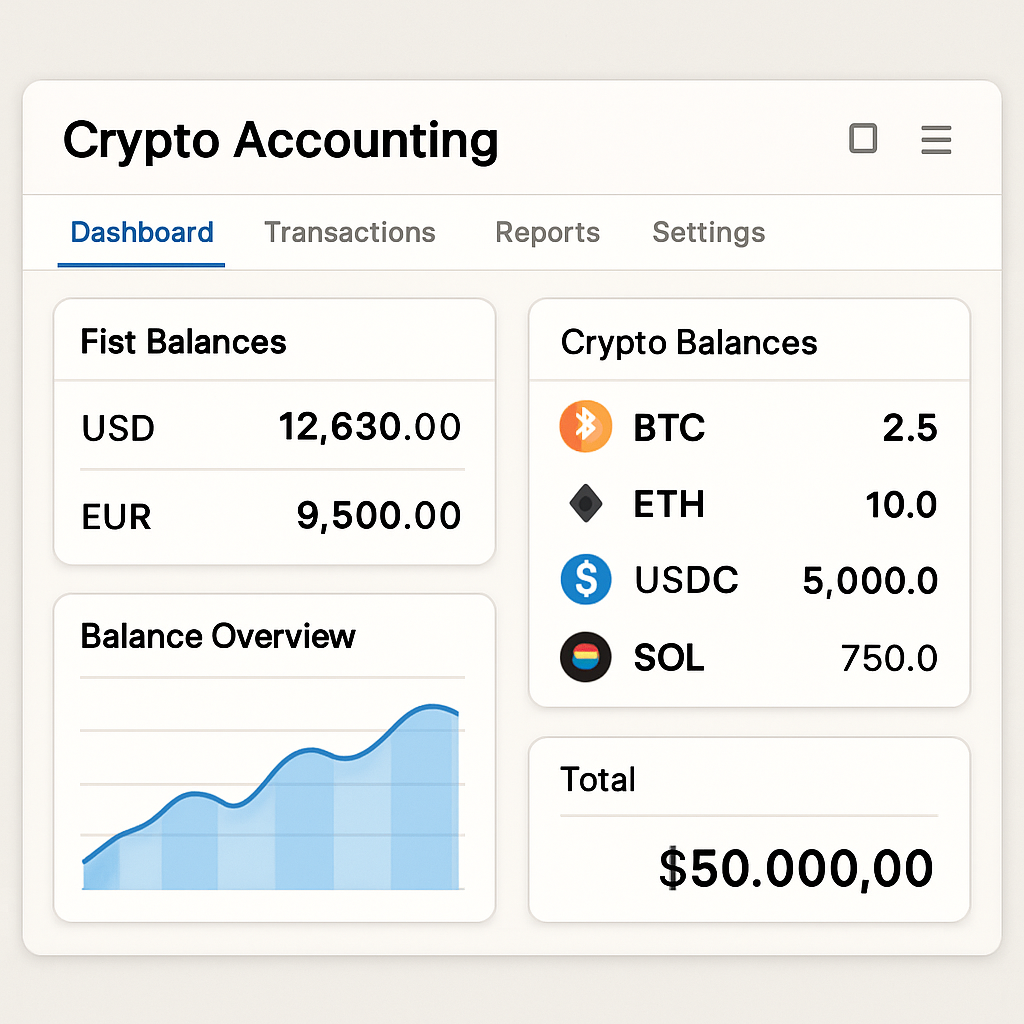
To solve this, you need the right tools. Finding the best crypto accounting software for small business operations is a game-changer. Platforms like Cryptio, Bitwave and Tactic are specifically built to pull data directly from blockchains and exchanges, translating complex crypto transactions into standardised accounting formats (like GAAP or IFRS).
Expense Tracking And Seamless Integrations
If you are paying vendors or buying software with crypto, you need to know exactly how to track bitcoin business expenses. It is not enough to simply note that 0.05 BTC left your wallet. You must record the exact fiat value of that Bitcoin at the very moment the transaction was executed.
Modern crypto accounting tools automate this by timestamping every transaction and fetching the historical price data. Furthermore, for mid-sized to large enterprises, establishing an integration between crypto payment gateways and ERP (Enterprise Resource Planning) systems like NetSuite, Xero or QuickBooks is vital. This integration ensures that when a customer pays an invoice via a Bitcoin payment processor (like BTCPay Server or BitPay), the invoice is automatically marked as paid in your traditional accounting software, seamlessly merging your crypto and fiat ledgers.
Streamlining Day-To-Day Corporate Operations
Once your infrastructure and accounting software are in place, you need to optimise your daily financial workflows. Managing a business that operates in both fiat and cryptocurrency requires agility.
Managing Payroll Across Borders
One of the most powerful use cases for Bitcoin in business is compensating international workers. Traditional wire transfers can take days and cost exorbitant fees, especially when dealing with emerging markets.
Managing crypto payroll for remote employees is incredibly efficient when done correctly. Platforms like Bitwage or Deel allow companies to fund payroll in fiat or stablecoins, while employees can choose to receive a percentage of their salary in Bitcoin. This eliminates cross-border friction, guarantees rapid settlement and serves as an excellent perk for crypto-enthusiast employees.
Handling Cash Flow And Fiat Conversions
Even if you are a staunch believer in Bitcoin, you likely still have fiat obligations – rent, taxes and software subscriptions usually require traditional currency.
To maintain healthy cash flow, you must focus on simplifying crypto-to-fiat conversion workflows. Rather than manually logging into an exchange, selling Bitcoin, waiting for the trade to settle and transferring it to your bank, you can use automated treasury management platforms. These tools allow you to set specific rules; for example, automatically converting 50% of all incoming Bitcoin payments into USD and routing it directly to your corporate bank account. This automation keeps your operational fiat reserves topped up without requiring manual daily intervention.
Corporate Treasury: Holding Bitcoin Long-Term
Since companies like MicroStrategy and Tesla added Bitcoin to their balance sheets, many smaller companies have followed suit. Using Bitcoin as a hedge against fiat inflation is a popular strategy but it requires careful planning.
Crafting A Startup Treasury Strategy
Effective bitcoin treasury management for startups involves treating Bitcoin as a long-term reserve asset rather than a short-term trading vehicle. Startups often suffer from cash drag holding too much cash in a low-interest bank account while inflation eats away at purchasing power. Allocating a sensible percentage of treasury reserves to Bitcoin can protect your purchasing power over a multi-year time horizon.
Mitigating Market Volatility
Of course, Bitcoin is famous for its price swings. A 20% drop in a week can spell disaster for a company that hasn’t planned its cash flow correctly.
Reducing volatility risk in corporate bitcoin holdings is all about liquidity management. The golden rule is: never hold funds in Bitcoin that you will need to spend in the next 12 to 18 months. Ensure that your short-term operational expenses are fully funded in fiat currency or stablecoins (like USDC). Only allocate excess, long-term capital to your Bitcoin treasury. Additionally, some businesses use crypto derivatives or yield-generating platforms to hedge their positions, though these introduce counterparty risks that must be carefully evaluated.

Navigating Taxes, Compliance And Audits
The biggest fear most business owners have regarding cryptocurrency is running afoul of tax authorities or regulators. Because the space is highly scrutinised, transparency and adherence to the law are non-negotiable.
The Tax Implications Of Crypto Transactions
Founders frequently ask: exactly what are the tax implications of bitcoin business transactions? In the United States and many other jurisdictions, tax agencies like the IRS treat Bitcoin as property, not currency.
In Australia, the Australian Taxation Office (ATO) treats Bitcoin and other crypto-assets almost identically to the IRS: they are classified as property and a Capital Gains Tax (CGT) asset, rather than as money or foreign currency.
This means that every single time you dispose of Bitcoin, it is a taxable event. If you buy a $2,000 laptop using Bitcoin that you acquired when it was worth $1,000, you have just realised a $1,000 capital gain, which is subject to taxation. It does not matter that you bought goods instead of cashing out to fiat; the disposal itself triggers the tax liability. This applies to paying employees, paying vendors and swapping Bitcoin for another cryptocurrency.
However, Australia has a few unique rules that differ from the US system, particularly regarding personal use and long-term discounts.
1. The “Personal Use Asset” Exemption
Unlike the US, Australia has a specific (though narrow) exemption for small personal transactions.
- The Rule: If you use Bitcoin to buy goods or services for personal use or consumption (e.g. concert tickets or a coffee) and the cost of the Bitcoin was less than $10,000 AUD, it may be exempt from CGT.
- The Catch: This only applies if you acquired the Bitcoin and used it in a short period of time. If you held the Bitcoin for a long time as an investment and then decided to spend it on a personal item, the ATO will likely still view it as an investment asset, meaning the exemption won’t apply.
2. The 50% CGT Discount
For most Australians who are classified as “Investors” (rather than professional “Traders”), holding Bitcoin long-term is highly tax-efficient.
- If you hold your Bitcoin for more than 12 months before selling or swapping it, you are generally eligible for a 50% CGT discount.
- This means you only pay tax on half of the profit you made from that transaction.
3. Taxable Events In 2026
Under current ATO guidelines, a “disposal” occurs whenever you:
- Sell Bitcoin for AUD or any other fiat currency.
- Swap one crypto for another (e.g., trading Bitcoin for Ethereum).
- Gift Bitcoin to someone else.
- Use Bitcoin to pay for a business expense.
4. New Rule For High-Net-Worth Individuals (From July 2025)
A major change for the 2025–2026 financial year is a new 15% tax on unrealised gains for individuals with more than $3 million AUD in net assets or superannuation balances. For these individuals, the end-of-year value of their portfolio can trigger a tax bill even if they haven’t sold any assets.
5. Advanced Data Matching
The ATO has one of the world’s most robust data-matching programs. By 2026, it receives automated reports from almost every exchange operating in Australia (and many global ones) via the Crypto-Asset Reporting Framework (CARF). It is widely accepted that the ATO is likely already aware of your trading activity before you lodge your return.
Automating The Tax Burden
Calculating the cost basis for thousands of micro-transactions manually is mathematically impossible for a growing business. This is why investing in automated cryptocurrency tax reporting tools is mandatory.
These software solutions track your cost basis using your preferred accounting method (FIFO, LIFO or Specific Identification). At the end of the fiscal year, they automatically generate the necessary tax forms, detailing your short-term and long-term capital gains and losses.
Audits And Regulatory Compliance
As your business scales, you may face internal or external financial audits. Auditors will require undeniable proof of your transactions. One of the primary benefits of blockchain technology is that it acts as a public ledger, providing built-in audit trails for blockchain-based business payments.
However, a raw string of alphanumeric characters on a block explorer means nothing to an auditor. Your accounting software must map those public wallet addresses to known vendors, customers and invoices, providing context to the immutable on-chain data.
Furthermore, you must strictly adhere to the compliance requirements for crypto-native businesses. This includes implementing Know Your Customer (KYC) and Anti-Money Laundering (AML) procedures if you are acting as a money transmitter. Even if you are simply an e-commerce store accepting crypto, you must comply with local tax laws, issue 1099s to independent contractors paid in crypto and ensure you are not doing business with sanctioned wallet addresses flagged by agencies like the Office of Foreign Assets Control (OFAC).
Common Mistakes To Avoid
As you integrate these practices, be mindful of the common pitfalls that ensnare new crypto-friendly businesses:
- Commingling Funds: Never mix personal crypto assets with your business treasury. Open dedicated corporate wallets and exchange accounts.
- Losing Access To Keys: If you do not use multi-sig, relying on a single paper backup for a seed phrase is highly risky. Protect your keys with enterprise-grade custody solutions.
- Ignoring Network Fees: Gas and network fees can eat into profit margins if you are processing a high volume of micro-transactions on the main chain. Consider using the Lightning Network for small payments.
- Procrastinating On Bookkeeping: Do not wait until tax season to reconcile your crypto transactions. Sync your wallets to your accounting software weekly or monthly.

Conclusion
Transitioning your business to operate on a Bitcoin standard whether fully or partially offers incredible advantages. It opens up a global customer base, allows for borderless / instant payroll and provides a hedge against traditional fiat inflation. However, the decentralised freedom of cryptocurrency must be matched by rigorous, centralised accounting practices within your company.
By setting up secure multi-sig wallets, utilising specialised banking and leveraging powerful software integrations, you can completely demystify the process of corporate crypto accounting. The easiest way to manage bitcoin business finances is to automate your data collection, separate your operational cash from your long-term treasury and always maintain strict compliance with tax regulations.
When you put the right infrastructure in place today, you future-proof your business for tomorrow’s digital economy, allowing you to focus on growth, innovation and success rather than drowning in spreadsheets.