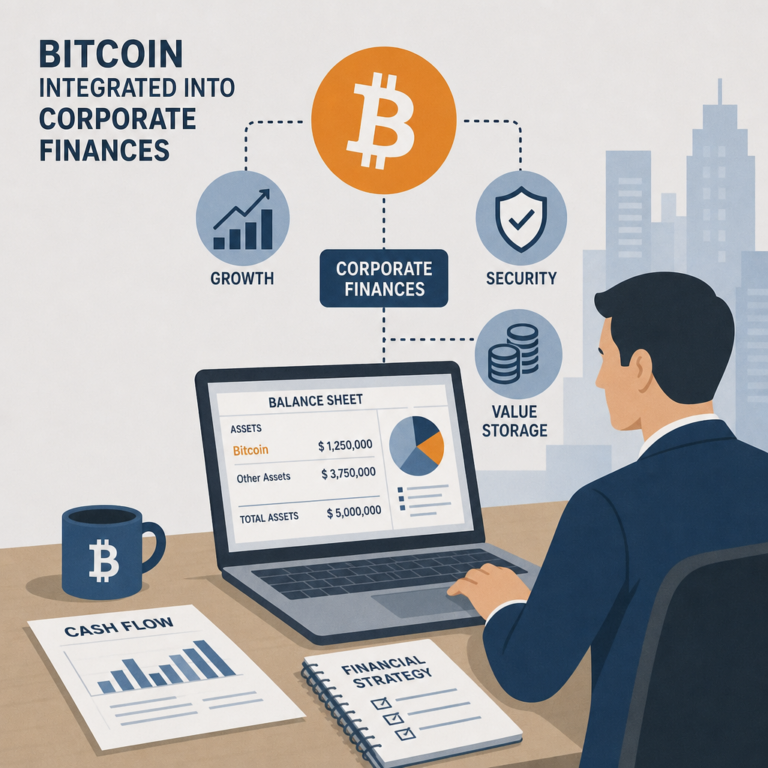
Should Bitcoin Be Part Of Our Treasury Reserve?
A Strategic Question For Modern Businesses
As inflation persists, interest rates fluctuate and cash reserves lose purchasing power, more businesses are asking a once-unthinkable question:
Should Bitcoin be part of our treasury reserve?
This is no longer a fringe discussion. Public companies, private firms and family businesses around the world are now holding Bitcoin alongside cash, term deposits and traditional investments.
This article explores why businesses consider Bitcoin for treasury, the risks involved and how to think about allocation responsibly.
What Is A Treasury Reserve?
A treasury reserve exists to:
- Preserve purchasing power
- Maintain liquidity
- Fund operations and growth
- Provide resilience during economic uncertainty
Traditionally, treasury reserves include:
- Cash
- Term deposits
- Money market instruments
- Short-term government securities
Bitcoin introduces a new category: a scarce, digital, non-sovereign monetary asset.
Why Businesses Are Considering Bitcoin
1. Cash Is Losing Purchasing Power
Inflation erodes cash over time.
Even at moderate inflation rates, long-term cash reserves steadily lose real value.
Bitcoin has:
- A fixed supply of 21 million coins
- No central issuer
- Predictable monetary policy
For some businesses, Bitcoin functions as a long-term hedge against monetary debasement.
2. Bitcoin Is A Long-Term Store Of Value
While volatile in the short term, Bitcoin has historically:
- Appreciated over multi-year periods
- Outperformed many traditional assets
- Shown increasing institutional adoption
Treasury Bitcoin is not a trade—it’s a strategic, long-term holding.
3. Portfolio Diversification
Bitcoin behaves differently from:
- Cash
- Equities
- Bonds
- Property
Adding a small Bitcoin allocation can improve risk-adjusted returns by diversifying treasury assets.
4. Global, Liquid And Borderless
Bitcoin:
- Trades 24/7
- Settles globally in minutes
- Is not tied to any single country or bank
- Can be custodied directly by the business
This makes it uniquely flexible for international businesses.
The Risks Businesses Must Consider
Bitcoin is not risk-free and it is not suitable for every business.
1. Price Volatility
Bitcoin’s price can fluctuate significantly in the short term.
This makes it unsuitable for:
- Operational cash
- Payroll funds
- Short-term liabilities
Treasury Bitcoin should be capital that is not needed in the near term.
2. Accounting Treatment
Under current accounting standards, Bitcoin is treated as an intangible asset and subject to impairment.
This can result in:
- Conservative-looking balance sheets
- Unrealised upside not reflected in profits
Finance teams must be comfortable with this treatment.
3. Custody & Operational Risk
Poor key management can result in permanent loss.
Strong custody practices are non-negotiable:
- Multi-signature wallets
- Clear internal controls
- Documented recovery plans
4. Regulatory & Tax Considerations
Bitcoin regulations and tax treatment continue to evolve.
Businesses must:
- Maintain proper records
- Understand CGT implications
- Stay informed on regulatory changes
Professional advice is essential.
How Businesses Typically Allocate Bitcoin
There is no universal allocation—but patterns are emerging.
Common starting allocations:
- 1–5% of treasury reserves for conservative businesses
- 5–10% for higher-conviction strategies
Many businesses:
- Start small
- Dollar-cost average over time
- Increase allocation as confidence grows
The key principle is intentional allocation, not speculation.
Bitcoin Vs Cash: A Treasury Comparison
|
Cash |
Bitcoin |
|---|---|
|
Inflationary |
Fixed supply |
|
Central bank controlled |
Decentralised |
|
Stable nominal value |
Volatile short term |
|
Loses purchasing power |
Potential long-term appreciation |
Bitcoin is not a replacement for cash—it’s a complement.
When Bitcoin Makes Sense For Treasury
Bitcoin may be appropriate if your business:
- Has excess cash beyond operating needs
- Has a long-term time horizon
- Can tolerate volatility
- Has strong governance and controls
- Understands custody and accounting requirements
Bitcoin is not appropriate for businesses struggling with liquidity or short-term obligations.
A Sensible Framework For Decision-Making
Before adding Bitcoin to treasury, ask:
- What problem are we trying to solve?
- How much capital can we allocate long-term?
- What allocation aligns with our risk tolerance?
- Do we have proper custody and governance?
- Are our directors aligned and informed?
If these questions can not be answered clearly, pause.
Final Thoughts
Bitcoin is emerging as a legitimate treasury reserve asset—but only when used thoughtfully.
For the right business, Bitcoin can:
- Protect purchasing power
- Improve diversification
- Strengthen long-term financial resilience
For the wrong business, it can introduce unnecessary risk.
The goal is not to “bet on Bitcoin”, but to allocate responsibly as part of a diversified treasury strategy.